
Dental Bridges
What Are Dental Bridges?
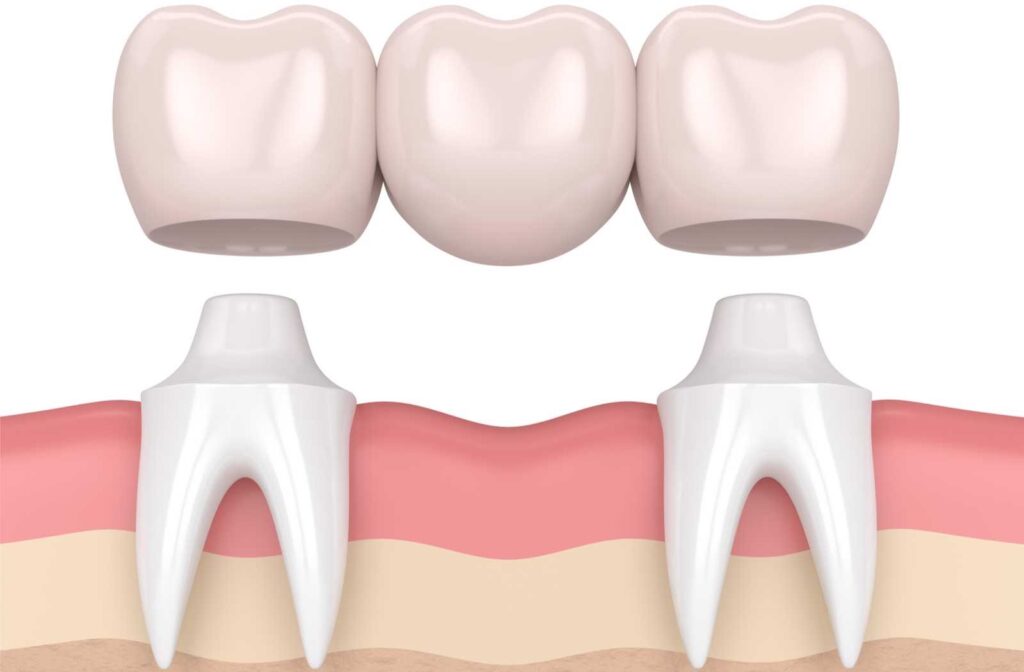
A dental bridge is a custom-fitted, permanent dental prosthesis that replaces one or multiple consecutive missing teeth. It consists of two core components: abutment crowns and pontics (false teeth). The abutment crowns are secured to your healthy natural teeth or dental implants on both sides of the gap, while the pontic sits perfectly in the empty tooth space to fill the gap. Once cemented in place, the bridge becomes a fixed, stable part of your dentition, indistinguishable from natural teeth in appearance and daily function.
Unlike removable dentures, dental bridges are permanently fixed and require no removal for cleaning or maintenance, offering unmatched comfort and convenience for daily use.
Common Reasons to Get a Dental Bridge
Our dentists recommend dental bridges for patients with the following oral conditions:
- Single or multiple consecutive missing teeth in the front or back dental arch
- Shifting or drifting adjacent teeth caused by long-term tooth loss
- Weakened chewing ability and uneven bite pressure due to tooth gaps
- Slurred speech or pronunciation issues resulting from missing teeth
- Sunken facial appearance and premature aging caused by tooth and bone loss
- Patients seeking a non-removable, cost-effective alternative to dental implants
Four Main Types of Dental Bridges
We offer customized bridge solutions tailored to your tooth position, oral structure, budget, and aesthetic needs:
1. Traditional Fixed Bridge
The most common and classic bridge type, ideal for gaps surrounded by healthy natural teeth on both sides. Healthy adjacent teeth are trimmed and fitted with abutment crowns to support the middle pontic tooth. It boasts exceptional stability and is suitable for both anterior and posterior teeth.
2. Cantilever Bridge
Designed for situations where only one side of the tooth gap has healthy natural teeth. The bridge is anchored to a single abutment tooth, with no support on the opposite side. This minimally invasive option preserves more tooth structure and is mostly used for front tooth restoration with low chewing force.
3. Resin-Bonded (Maryland) Bridge
A minimally invasive, metal-free restoration perfect for front tooth gaps. Instead of trimming healthy teeth, the bridge framework is bonded to the inner surface of adjacent teeth with strong dental resin. It causes minimal tooth damage, features excellent aesthetics, and is ideal for young patients with intact healthy teeth.
4. Implant-Supported Bridge
The most durable and long-lasting option for multiple missing teeth. Instead of relying on natural teeth for support, the bridge is anchored firmly on dental implants. It requires no grinding of healthy adjacent teeth, prevents jaw bone loss, and offers the closest simulation of natural tooth function and lifespan.
Key Benefits of Dental Bridges
- Restores full chewing function and balanced bite force
- Prevents tooth shifting, bone loss, and gum recession
- Corrects speech impairments caused by missing teeth
- Preserves facial contour and avoids sagging facial skin
- Fixed and stable – no slipping or movement during eating or speaking
- Natural aesthetic effect that blends seamlessly with original teeth
- Cost-effective compared to full implant restoration for single-tooth gaps